
No stranger to the macabre, Ross Palmer Beecher's work spans graveyard quilts to tin tombstones. This Halloween, dig deeper into Beecher's career with the full catalogue essay by curator Christian Waguespack, published in conjunction with MoNA's recent exhibition, Ross Palmer Beecher: Speaking in the Vernacular.
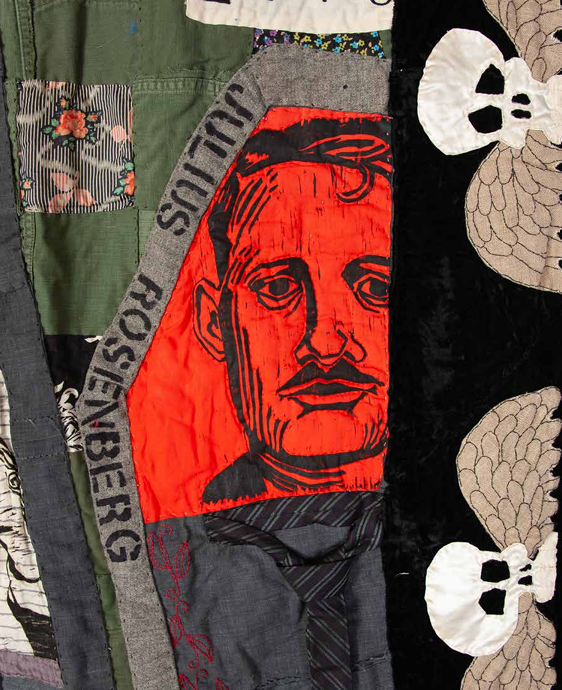
Ross Palmer Beecher, Graveyard Quilt (detail), 1978–81. Hand-carved woodblocks printed on fabric and embroidery floss, 84 × 77 in. overall. Courtesy of Greg Kucera Gallery, Seattle
Ross Palmer Beecher is a Seattle-based mixed-media artist celebrated for her inventive use of upcycled and found materials—including aluminum cans, metal scraps, wood, fabric, and everyday objects—which she transforms through techniques inspired by quilting, folk art, assemblage, and other media and practices that have traditionally been excluded from the toolbox of “fine art.” Beecher recalls, “I learned in school that printmaking was used to print literature, and that a silkscreen was not art. Andy Warhol made it into art. Lithography was for publication; Toulouse-Lautrec made it into art. Dürer and all those guys, they made printmaking into art.” In true iconoclastic spirit, Beecher’s work challenges material hierarchies, and the segregation of art and craft, in the larger world.
Recalling Americana traditions, she blends humor and irony with mercy, compassion, and tenderness. Beecher has found inspiration in Americana folk art forms such as quilting, New England funerary art, offbeat flag-making, folk portraiture, and outsider art. Beecher’s interest in Americana comes from the perspective of both content and practice. Her work references figures who have shaped the nation’s social and cultural history, including Sylvia Plath, Tim Burton, David Lynch, Martin Luther King Jr., Benjamin Franklin, and presidents from Washington to Kennedy. Both her materials and her content live in the world of the everyday. Uninterested in the language of the art world and the academy, her world reflects American vernacular dialect, culture, and material.
In the art world, “vernacular art” suggests creative practices produced by self-taught artists operating outside formal art academies and institutional frameworks. In this sense, Beecher’s relationship to vernacular art is ambiguous. Having studied at the Rhode Island School of Design, maintained steady gallery representation, and placed work in major art museums, she has proven herself in fine-art institutional frameworks. But aesthetically the work she has produced feels more at home with the often-unsung pantheon of American folk artists who, through their use of accessible, everyday materials and narratives, have enriched the past century with artworks rooted in local culture, daily life, and personal experience. Sculptures made from found materials, quilts, assemblage, and paintings on recycled surfaces are all part of the vocabulary of vernacular art, a language Beecher speaks fluently.
Yet the label of “folk artist” does not adequately or accurately convey the rich quilt that constitutes her life in the arts. Beecher’s work is not without its antecedents in the institutional fine-arts canon. Her use of assemblage and unconventional arts materials calls to mind Joseph Cornell, artists of the Dada and Arte Povera movements, and of course Robert Rauschenberg, who had a profound influence on her practice. In her incorporation of mass-produced consumer materials and images of recognizable cultural icons—not to mention her tongue-in-cheek wit— she has her feet firmly planted in the Pop work of Andy Warhol, Jasper Johns, Roy Lichtenstein, Richard Hamilton, and Roger Shimomura.
Nostalgia provides a vital component to Beecher’s creative worldview. Her vocabulary of content pulls almost exclusively from the late nineteenth century and, more prominently, early twentieth century. Because of this temporal crystallization, Beecher’s cast of characters and collective narratives is built on a foundation of the collective past, stories and personas who have passed into the realm of the mythic and iconic. While the references remain rooted in the retro, the work brings relevance and engagement to contemporary viewers through Beecher’s unexpected use of materials and deeply human embodiments of compassion, wonder, critical wit, humor, and empathy.
Gallerist Greg Kucera once suggested that “Ross works in circles.” Indeed, her practices, themes, and trajectory are anything but linear. Instead of going through “periods,” Beecher tends to work on several pieces at once, moving from one thing to another and back fluidly, and returning to past projects over time. While subjects and processes may overlap, from a bird’s-eye view some key themes appear across her career. With this in mind I would like to use Graveyard Quilt, made between 1978 and 1981, as a path along which we can visit several key motifs prominent across Beecher’s work, namely: quilt-making, graveyard imagery, portraits, Americana, and political and social history. A look at Beecher’s Graveyard Quilt can offer a patchwork of themes that reappear across her oeuvre and gives us a chance to examine some of these conceptual fragments through an evaluation of a single object.
The quilt itself is large, eighty-four by seventy-seven inches. The composition is dense and rich, bringing in various media, textiles, patches, hand embroidery, and the printed image. Displaying quilts as fine art involves overcoming historical biases, including problems of orientation—whether to exhibit them horizontally (as utilitarian) or vertically (as painting). Though quilts are often displayed on a wall, they were of course originally intended to lie on a bed, a fact that plays with orientation and our physical intimacy with the piece. The display presents a cognitive dissonance between what we see, what we know, and our understanding of how we may interact with the object. While our knowledge of the material and conceptual roots of the quilt suggest domesticity, intimacy, and comfort, the presentation as a wall hanging visually hearkens to the language of fine art painting, creating distance and a presupposition of an aesthetic or intellectual entry point to understanding an object that was traditionally meant for practical or emotional consideration. This conceptual double standard is an ongoing problem when the traditionally vernacular is brought into intellectualized or aestheticized spaces.
Quilts are a major theme throughout Beecher’s work, and the inspiration has roots deep in her childhood. She tells the story of a weekend when, while she was a young girl in New England, her sister took a trip to New York, visiting the Whitney Museum, which was hosting an exhibition of New England quilts, and brought back images from the show. From these images Beecher was inspired to make her own quilts, asking people on her paper route to donate scraps of fabric.
Graveyard Quilt is a more traditional quilt than some of hers in that it is composed of pieces of found fabric, with the background primarily in the forest green of military surplus.
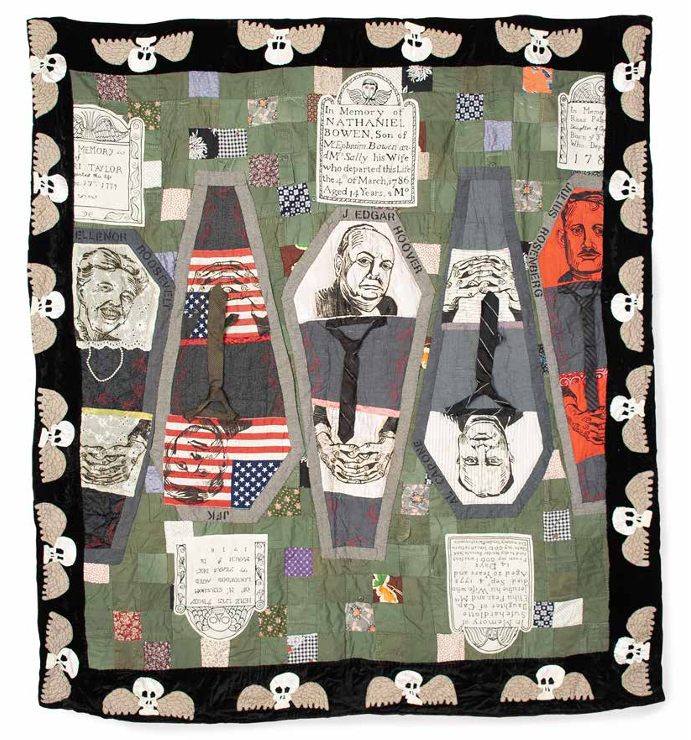
Ross Palmer Beecher, Graveyard Quilt, 1978–81. Hand-carved woodblocks printed on fabric and embroidery floss, 84 × 77 in. Courtesy of Greg Kucera Gallery, Seattle
The geometric green grids call to mind a patchwork of cemetery plots, with various other found scraps adding pops of color and texture. Other found materials include lace, neckties—which Beecher has returned to for other sewing projects—and a string of pearls around the neck of Eleanor Roosevelt.
Though Graveyard Quilt is primarily textile based, Beecher’s quilts go on to include a kaleidoscope of unconventional materials, primarily metal. The bridge moment into making metal quilts happened when Beecher moved to the West Coast. An encounter with a portrait of Our Lady of Guadalupe framed in metal AA battery casings at La Tienda Folk Art Gallery in Seattle triggered a profound shift in Beecher’s work, prompting a connection between readily available, free recycled material and the environmental benefit of reusing those in her art. Over time Beecher became enamored of products that were used and discarded, particularly soda and tin-can graphics. She began the folk art of “quilting” pieces of soda cans together, mixing color combinations. This was a way of recycling aluminum, of cleaning the city. She was particularly attracted to the challenge of making a throwaway into something much more beautiful and beyond what the object was intended to be used for. In addition to the ecological benefits of using upcycled materials, there is a cultural component at work here for Beecher. True to her New England roots, much of her artistic practice is inspired by a Yankee “do it yourself” sensibility, the colonial practices of making do with the everyday materials at hand, and what she calls “the joy of resourcefulness that has become a way of life.”
Most of Beecher’s quilts use the formal conventions of traditional American quilt design—log cabin, twisted log cabin, lone star, tumbling blocks, parlor fan, pinwheel, and so on. Within the quilts, Beecher’s visual language returns to the world of Pop. Beecher populates the regular, regimented, and repeating squares with mass-produced consumer content à la Warhol. Cigar boxes, Hershey’s cans, 7-UP logos, vinyl records, lotto tickets, bullets, and checkerboards fill the dynamic undulating spaces patterned across her recycled metallic quilts. For Beecher, this can be about sparking wonder as much as it is about form or a social or ecological message. “People are humored when they see a common graphic, such as a Coke can, integrated into a grand-scaled banner or quilt.” She says, “People marvel at the fun, color, and cheerfulness of these quilts.”
Ross Palmer Beecher is a taphophile. Death, memento mori, and remembrance are powerful and pervasive threads that tie together several of her projects. Graveyard Quilt is surrounded by a thick border of black velvet, patterned with winged skulls, which we will return to later. Such black borders were a staple of Victorian mourning aesthetics and communication technology. Envelopes and letters announcing a death would be accompanied by a thick black border, a striking and immediately powerful visual proclamation of death’s arrival before the words could communicate the details of the passing. Mourning would be incorporated into the everyday aesthetics of the mourners announcing to their community that they themselves were not yet ready to fully rejoin the world of the living. This extended to letter writing, where the paper would also include a thick black border, which—for those who could afford custom stationery—would become thinner as the letter writer passed through the period of mourning. So, in this visual tradition, Beecher’s incorporation of the black velvet border works as an initial visual signifier of death before we, the viewer, can began to parse out the remaining visual iconography and text.
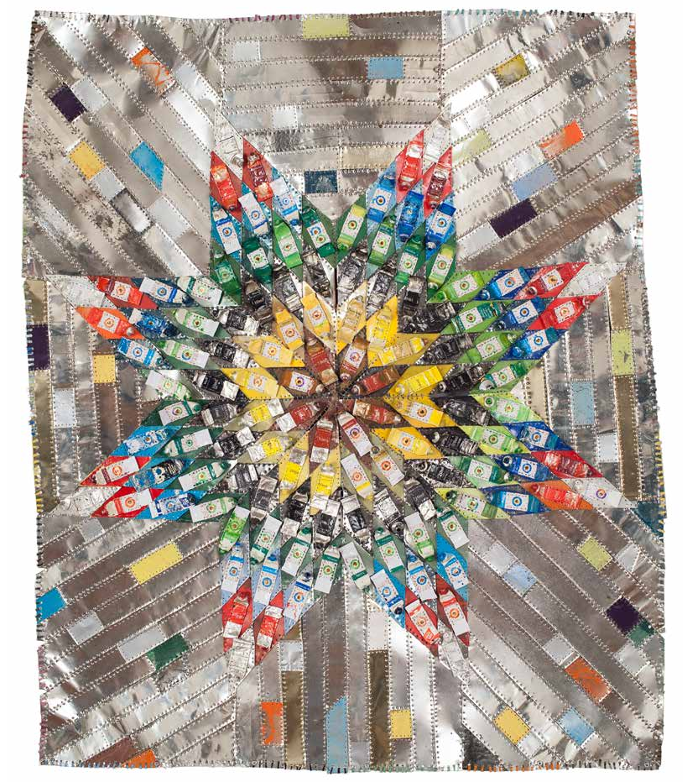
Ross Palmer Beecher, My Palette #2, 2013. Spray cans, paint tubes, and foil, 46 × 38 in
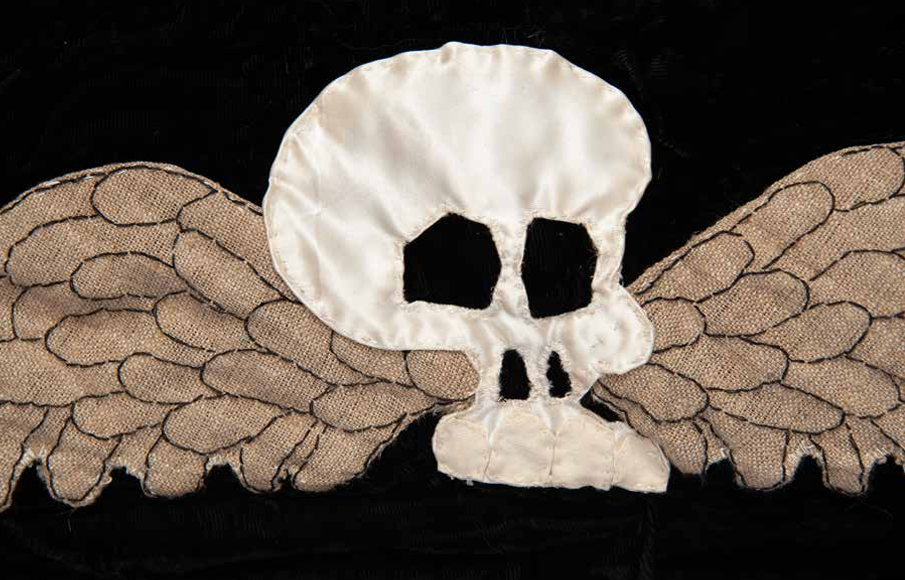
Graveyard Quilt (detail)
The aesthetics of the New England graveyard show up again as inspiration for the Tombstones series. Five tombstones appear across the surface of Graveyard Quilt. The text and designs are embroidered by hand on muslin fabric. Beecher chose muslin because it is a humble fabric and one often used to make death shrouds for bodies. Two of the tombstones are cut off, suggesting a repetition and continuation past the borders of the quilt. A close look at one of the cutoff headstones reveals a macabre self-reference of the artist. In the United States, the funerary industry has produced an art world all its own, with different regions often developing distinctive visual languages. Few American grave styles have become as iconic as those of New England. The arches across the tops of headstones, inscribed with winged skulls over a rectangular base packed with text, and even the font of that text, identify these tombstones as distinctly New England. This is a visual style that has fascinated Beecher since childhood, when she would often play in local graveyards, once even finding someone’s plot broken open with the soil sunken in and lying down in it so her friend could get a picture. Beecher is also interested in New England headstones as an authentic American folk-art practice, with the artists being nonspecialized working-class carvers who did other work for a living.

Ross Palmer Beecher, Sylvia Plath Memento Mori, 1983. Perforated tin and wire, 18 × 14½ × 2½ in. Courtesy of Greg Kucera Gallery, Seattle
The tombstone designs were originally intended for another project in which Beecher would silkscreen them onto shirts, calling the project the Cemetery Shirtworks. When this project didn’t turn out, she decided to incorporate them into the Graveyard Quilt instead. Beecher continues to reference New England headstones in other sculptural projects. The first was her Sylvia Plath Memento Mori, from 1983, made out of perforated tin and wire. The wall-based sculpture maintains the basic composition common to New England headstones: a curved top with a winged angel head, symbolizing the soul’s flight to heaven and the promise of resurrection; decorative scrollwork along the sides; and a prominent quote across the surface reading, “Even amidst fierce flames the golden lotus can be planted.” Beecher’s sculpture is a metal replica of Plath’s gravestone in Heptonstall, West Yorkshire, chosen by her husband, Ted Hughes. The quote, a metaphor for the late author’s battle with depression, evokes the idea of creating beauty or enduring life amid extreme suffering or trauma. Not all Beecher’s tombstones are direct references to existing memorial markers. In her tombstone for Vincent van Gogh, she replaces 37 the traditional winged figure at the top of the stone with an artist’s palette, equipped with two paintbrushes and paints at the ready. The inscription reads, “Art is to console those who have been broken by life,” Van Gogh’s own profound reflection on the power of creativity to mend wounded hearts. This reflection on art’s therapeutic powers is all the more relevant in light of Beecher’s work managing the art therapy program at Bailey-Boushay House, which provides care to people with HIV/AIDS as well as end-of-life care for people with ALS and other complex conditions.
While these pieces can be emotionally heavy, humor plays a significant role in Beecher’s interest in graveyard iconography. She is particularly drawn to graveyard humor in the form of witty epitaphs. Among her favorites, which she is able to recite from memory, goes something like: “Here lies the body of Solomon Pease; beneath these clouds and beneath these trees / But this ain’t Pease—it’s just the pod, Pease shelled out and went to God.” Graveyard Quilt is a reflection on death, particularly its universality—death as the great equalizer. Birth and death bookend everyone’s story. Across her Tombstones series and other various memento mori, in humor and in sorrow, in the leveling action of death, these sculptures remain poetic, theatrical, humbling, and poignant at the same time.
The tombstones represent a type of portraiture, portraits of figures in their own absence. More conventional portraits constitute a major genre of Beecher’s work. Across Graveyard Quilt’s center we have a hopscotch of five coffins, their alternating orientations further obscuring any sense of orientation for this piece. Within each coffin is a woodcut portrait of a historic individual who landed in Beecher’s cemetery. Beecher randomly picked this motley crew of portraits because they represent the good, the bad, and the ugly in modern American history— victims, thieves, and loved ones. Eleanor Roosevelt, John F. Kennedy, J. Edgar Hoover, Al Capone, and Julius Rosenberg all convene in Beecher’s quilt, shoulder to shoulder in their graves. Beecher’s woodcut burials call to mind Warhol and the cast of characters—often glamorous, often tragic—immortalized in his iconic portraits. Like Beecher, Warhol did not shy away from working with tragic figures in his Thirteen Most Wanted Men, his piece on Evelyn Francis McHale, the chilling electric chair that ended the life of Julius Rosenberg, and, most iconic, his portrait of Marilyn Monroe.
Beecher’s selection, reflecting an unwillingness to heroicize or vilify the individuals in her portraits, is a common trope across her work. She has worked on a pantheon of historic figures. While certain key figures in American history are present, such as Martin Luther King Jr., Benjamin Franklin, and Harriet Tubman, Beecher shows particular interest in presidential figures and film directors.
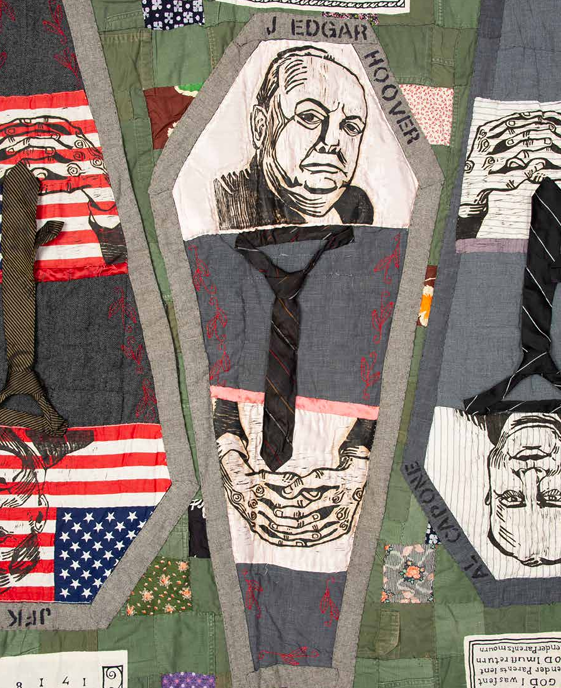
Graveyard Quilt (detail)
The film director project developed organically from her boyfriend’s interest in film. After she created a painting of director John Ford, her partner suggested she do a series of one-eyed directors, because of Ford’s eye patch. Beecher ran with half the idea and began to produce a series of film directors. While she was working on these, a friend down the street showed her how to assemble extendable cameras, and Beecher began to incorporate portraits of directors into the kind of cameras they would use. This collapsing of the creative and technological eye recalls surrealist practices of figurative portraiture and the post–World War II fascination with the mechanized body. The kinds of directors Beecher is drawn to—Fritz Lang, Tod Browning, David Lynch, Tim Burton—often reflect her interest in the darker side of culture. Though, as with much of the rest of her pantheon, Beecher is more interested in depicting the scope of the human experience than in heroicizing particularly valiant individuals, creating effigies of Leni Riefenstahl and Walt Disney side by side.
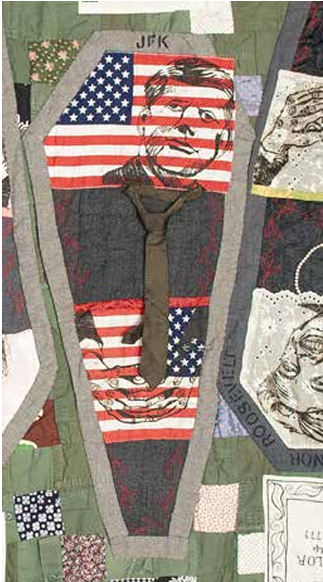
Graveyard Quilt (detail)
Likewise, Beecher’s presidential portraits run the political spectrum and are often playful in their iconography. Franklin Delano Roosevelt is luminous in a halo of dimes (and some pennies painted silver after the artist ran out of dimes), with his iconic cigar holder reaching out beyond the picture plane. George Washington is surrounded by notes marking that he “slept here,” “and here,” “and here,” a nod to the colonial practice of recording places significant historical figures visited during their campaigns, the pride in saying “George Washington once slept in this room” as a sign of pedigree, while also offering the tongue-in-cheek suggestion of the promiscuity that may have accompanied those visits—some cheeky irreverence that is quintessential Beecher.
Washington is crowned with a glorious American flag, that theme spinning off into an entirely different theme for Beecher, her flags. The flags exist at the radical center of Beecher’s artistic and personal interests. American flags hearken back to a childhood in which she recalls her parents’ enthusiasm for the flag, its almost constant presence in their home constituting a core memory for the young artist. She fostered an interest in flags as strong abstract design objects. She reflects how, in childhood, she was fascinated with the rich variety of flag designs she discovered in history books. As craft, they are quilts, and Beecher has made an entire series of fabric quilts based on the American flag with greater or lesser levels of embellishment. They recall the perhaps apocryphal story of Betsy Ross, a Philadelphia seamstress, and in this case folk artist, designing and sewing the first flag for George Washington in 1776. As with her quilts, Beecher has gone on to create a series of flags out of recycled materials, including bottle caps, soda cans, emergency signage, and gasoline signs, prompting critical commentary between American identity and the rampant consumerism that has overtaken the country throughout the past century. And of course, art historically, the flags bring us back yet again to pop art, the iconography of Warhol, and specifically the inspiration of Jasper Johns. In Graveyard Quilt the flag is the field against which JFK’s portrait is printed, recalling the iconic photographs of Kennedy’s funeral, the casket draped in the American flag, transforming it from national banner to burial shroud.
In its unpretentiousness, Beecher’s work reveals appreciation of the folk-art genre for its uninitiated yet genuine artistic aspirations and a satire of the sophisticated and snobbish art world. By drawing from craft traditions such as quilt-making, historically associated with the domestic and feminine sphere, Beecher also honors women’s work by repositioning these traditions within the discursive domain of art. At the same time, her work echoes the bold material transgressions of landmark figures in contemporary sculpture, including Joseph Cornell. Her practice blends satire with sincerity, humor with pathos, and craft with social commentary.
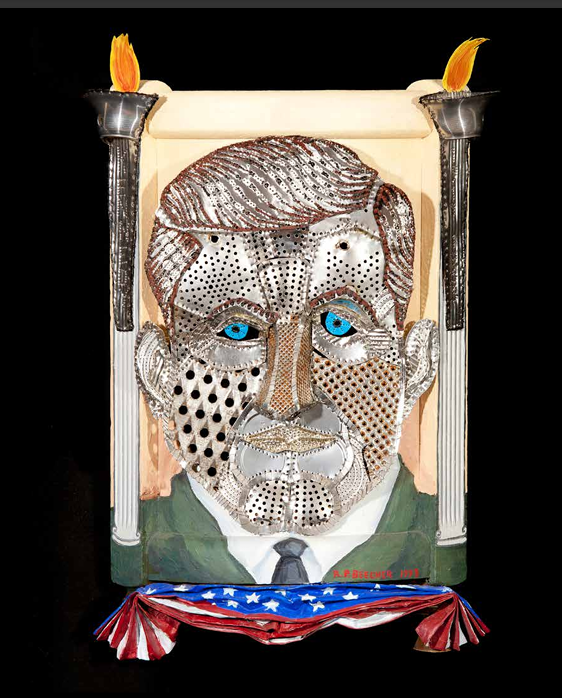
Ross Palmer Beecher, John F. Kennedy (J.F.K.), 1999. Oil on wired tin, acrylic on wood with found objects, 24 × 15½ × 6 in. Hallie Ford Museum of Art, Maribeth Collins Art Acquisition Fund 2011.021.003

Ross Palmer Beecher, Roosevelt (F.D.R.), 1999. Stitched and hammered metal, welded dimes and pennies, found glass objects and oil on metal, 20½ × 18½ × 2½ in. Courtesy of Greg Kucera Gallery, Seattle
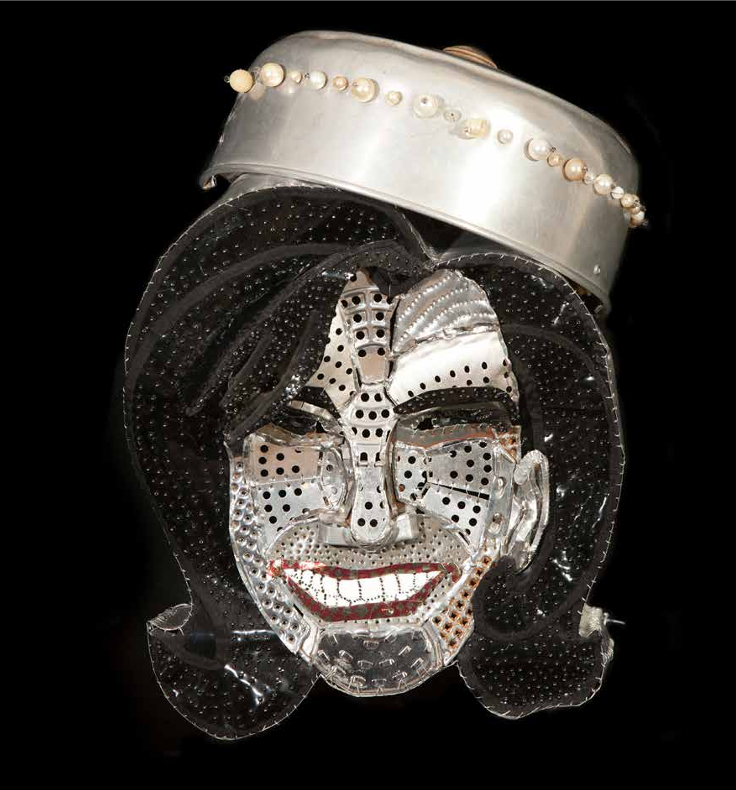
Ross Palmer Beecher, Jackie O (Kennedy), 2003. Wired-stitched metal, paint, costume jewery, 17 × 12 × 6 in., Hallie Ford Museum of Art, Maribeth Collins Art Acquisition Fund 2011.021.003
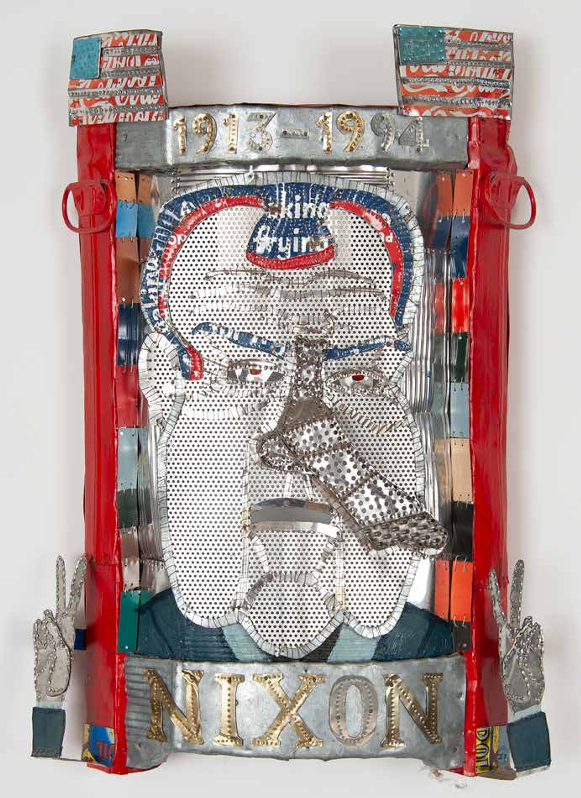
Ross Palmer Beecher, Nixon, 1998–99. Wired tin, paint on wood, 22 × 16 × 4 in
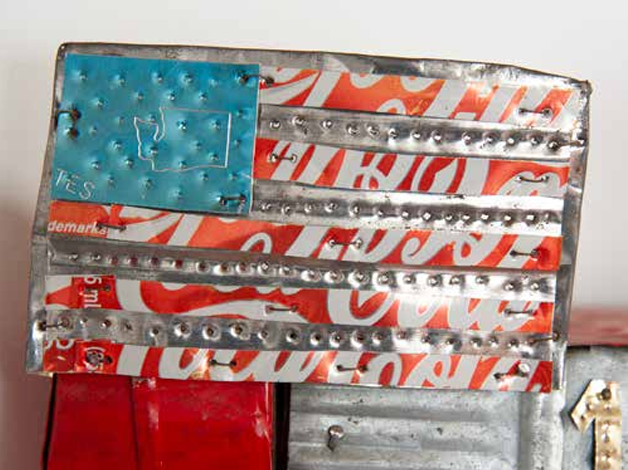
Ross Palmer Beecher, Nixon (detail), 1998–99. Wired tin, paint on wood, 22 × 16 × 4 in
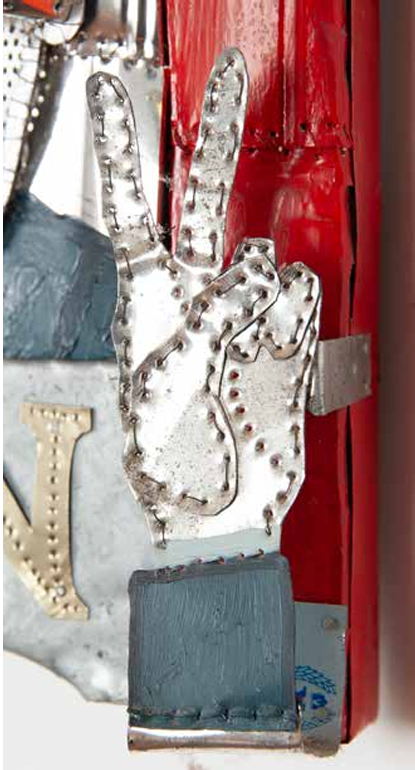
Ross Palmer Beecher, Nixon (detail), 1998–99. Wired tin, paint on wood, 22 × 16 × 4 in
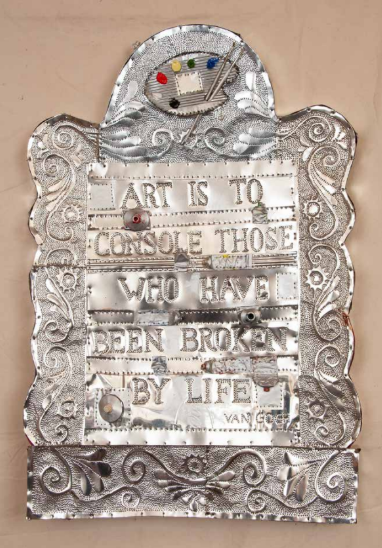
Ross Palmer Beecher, Van Gogh (Tombstone), 2021. Wired tin and paint, 30 × 20 × 2 in. Courtesy of Greg Kucera Gallery, Seattle
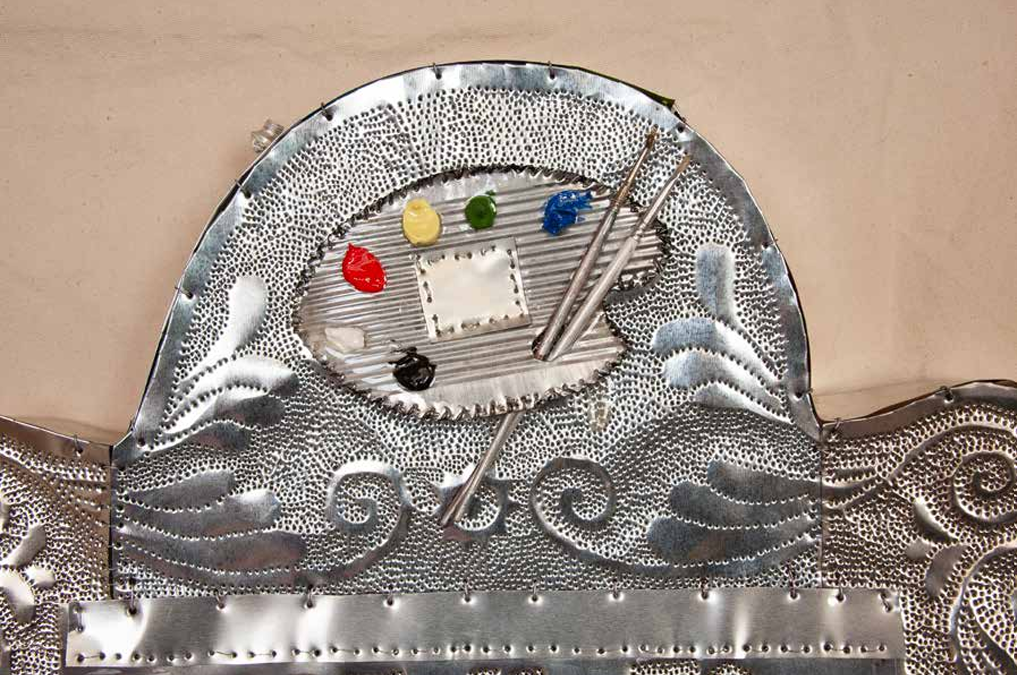
Van Gogh (Tombstone) (detail)
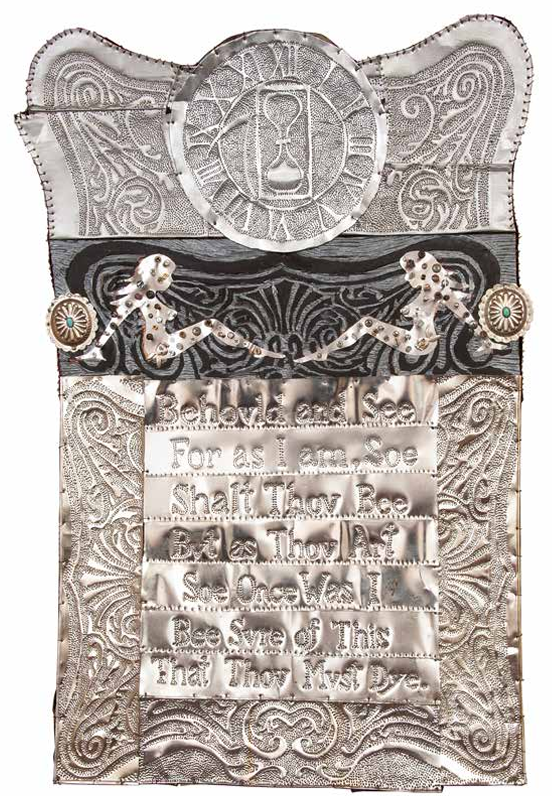
Ross Palmer Beecher, Bee Svre (Be sure of this), 2004. Paint on carved wood, wired tin, screws, 35 × 22 × 2 in. Courtesy of Greg Kucera Gallery, Seattle
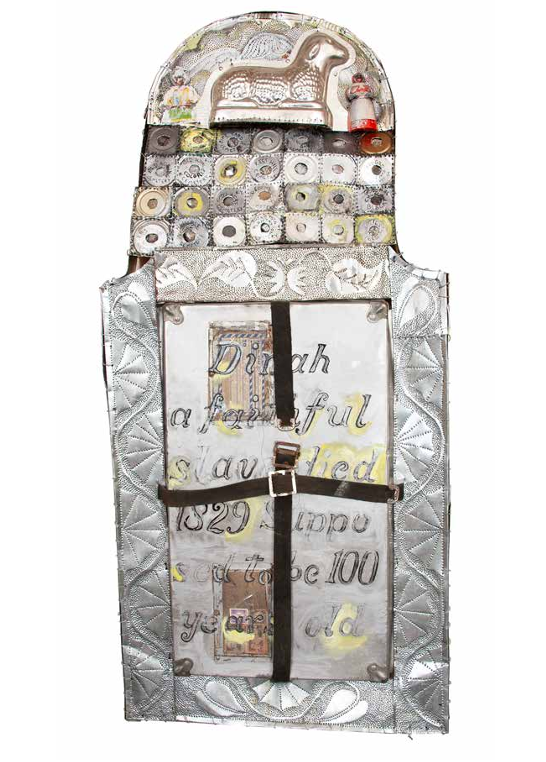
Ross Palmer Beecher, Dinah (Tombstone), 2025–26. Oils on wired metal, rocks, and found objects, 41 × 19 × 3 in. Courtesy of Greg Kucera Gallery, Seattle
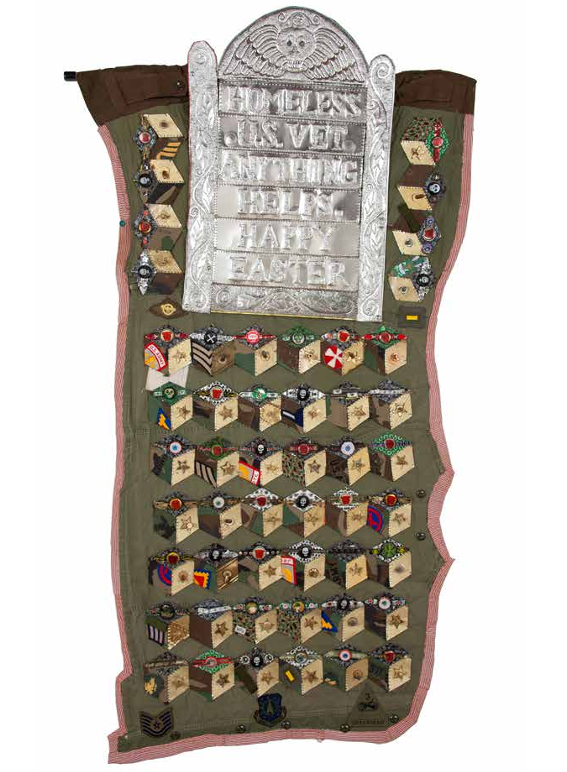
Ross Palmer Beecher, Happy Easter, 2017. Fabric, tin, oil paint, patches, bullet casings, and found objects, 60 × 33 in. Courtesy of Greg Kucera Gallery, Seattle
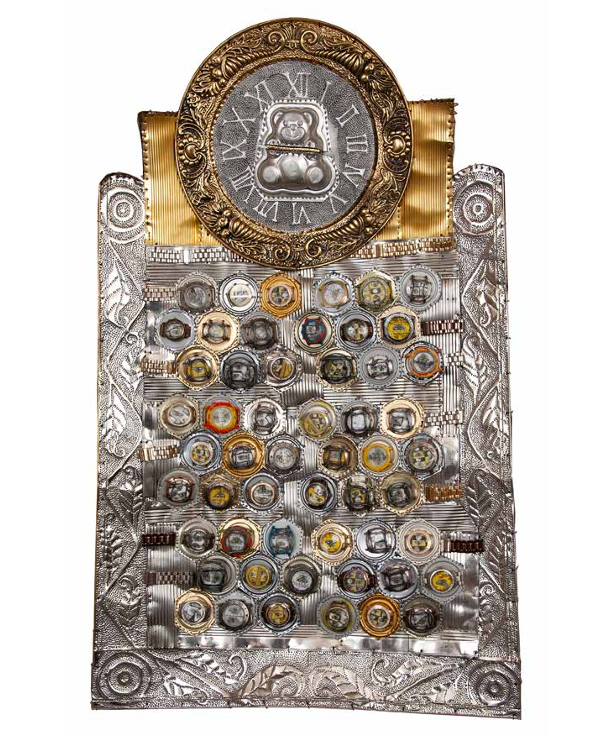
Ross Palmer Beecher, Time Piece (Tombstone with Bear and Bees), 2022–23. Oil paint, watches, and perforated tin, 41 × 25 × 3 in. Courtesy of Greg Kucera Gallery, Seattle
The above text and images are part of an essay by Christian Waguespack, Director of Curatorial Affairs & Curator of Northwest Art, published in the catalog Ross Palmer Beecher: Speaking in the Vernacular, published in 2026 by the Museum of Northwest Art.