
Ross Palmer Beecher: Memento Mori
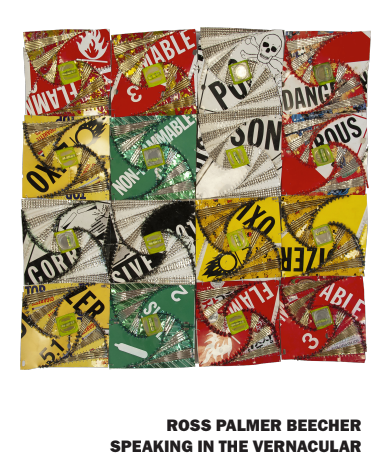
The following text is an edited down excerpt from a larger essay by Christian Waguespack, Director of Curatorial Affairs & Curator of Northwest Art, published in the catalog Ross Palmer Beecher: Speaking in the Vernacular, published in 2026 by the Museum of Northwest Art.
Gallerist Greg Kucera once suggested that “Ross works in circles.” Indeed, her practices, themes, and trajectory are anything but linear. Instead of going through “periods,” Beecher tends to work on several pieces at once, moving from one thing to another and back fluidly, and returning to past projects over time. While subjects and processes may overlap, from a bird’s-eye view some key themes appear across her career. With this in mind I would like to use Graveyard Quilt, made between 1978 and 1981, as a path along which we can visit several key motifs prominent across Beecher’s work, namely: quilt making, graveyard imagery, portraits, Americana, and political and social history.
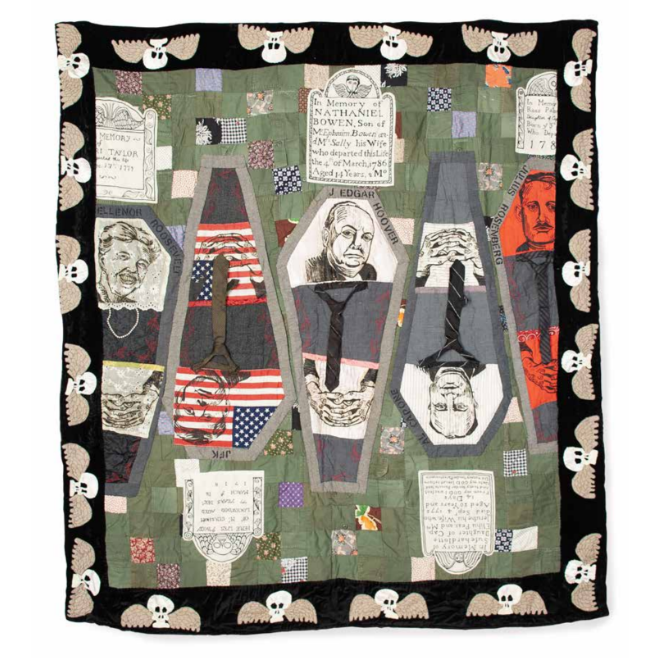
Ross Palmer Beecher, Graveyard Quilt, 1978–81, Hand-carved woodblocks printed on fabric and embroidery floss, 84 × 77 in, Courtesy of Greg Kucera Gallery, Seattle
The quilt itself is large, eighty-four by seventy-seven inches. The composition is dense and rich, bringing in various media, textiles patches, hand embroidery, and the printed image. Displaying quilts as fine art involves overcoming historical biases, including problems of orientation—whether to exhibit them horizontally (as utilitarian) or vertically (as painting). Though quilts are often displayed on a wall, they were of course originally intended to lie on a bed, a fact that plays with orientation and our physical intimacy with the piece. The display presents a cognitive dissonance between what we see, what we know, and our understanding of how we may interact with the object. While our knowledge of the material and conceptual roots of the quilt suggest domesticity, intimacy, and comfort, the presentation as a wall hanging visually harkens to the language of fine art painting, creating distance and a presupposition of an aesthetic or intellectual entry point to understanding an object that was traditionally meant for practical or emotional consideration. This conceptual double standard is an ongoing problem when the traditionally vernacular is brought into intellectualized or aestheticized spaces.
Though Graveyard Quilt is primarily textile based, Beecher’s quilts go on to include a kaleidoscope of unconventional materials, primarily metal. The bridge moment into making metal quilts happened when Beecher moved to the West Coast. An encounter with a portrait of Our Lady of Guadalupe framed in metal AA battery casings at La Tienda Folk Art Gallery in Seattle triggered a profound shift in Beecher’s work, prompting a connection between readily available, free recycled material and the environmental benefit of reusing those in her art. Over time Beecher became enamored of products that were used and discarded, particularly soda and tin-can graphics. She began the folk art of “quilting” pieces of soda cans together, mixing color combinations. This was a way of recycling aluminum, of cleaning the city. She was particularly attracted to the challenge of making a throwaway into something much more beautiful and beyond what the object was intended to be used for. In addition to the ecological benefits of using upcycled materials, there is a cultural component at work here for Beecher. True to her New England roots, much of her artistic practice is inspired by a Yankee “do it yourself” sensibility, the colonial practices of making do with the everyday materials at hand, and what she calls “the joy of resourcefulness that has become a way of life.”
Ross Palmer Beecher is a taphophile. Death, memento mori, and remembrance are powerful and pervasive threads that tie together several of her projects. Graveyard Quilt is surrounded by a thick border of black velvet, patterned with winged skulls. Such black borders were a staple of Victorian mourning aesthetics and communication technology. Envelopes and letters announcing a death would be accompanied by a thick, black border, a striking and immediately impactful visual proclamation of death’s arrival before the words could communicate the details of the passing. Mourning would be incorporated into the everyday aesthetics of the mourners announcing to their community that they themselves were not yet ready to fully rejoin the world of the living. This extended to letter writing, where the paper would also include a thick black border, which—for those who could afford custom stationery—would become thinner as the letter writer passed through the period of mourning. So, in this visual tradition, Beecher's incorporation of the black velvet border works as an initial visual signifier of death before we, the viewer, can begin to parse out the remaining visual iconography and text.
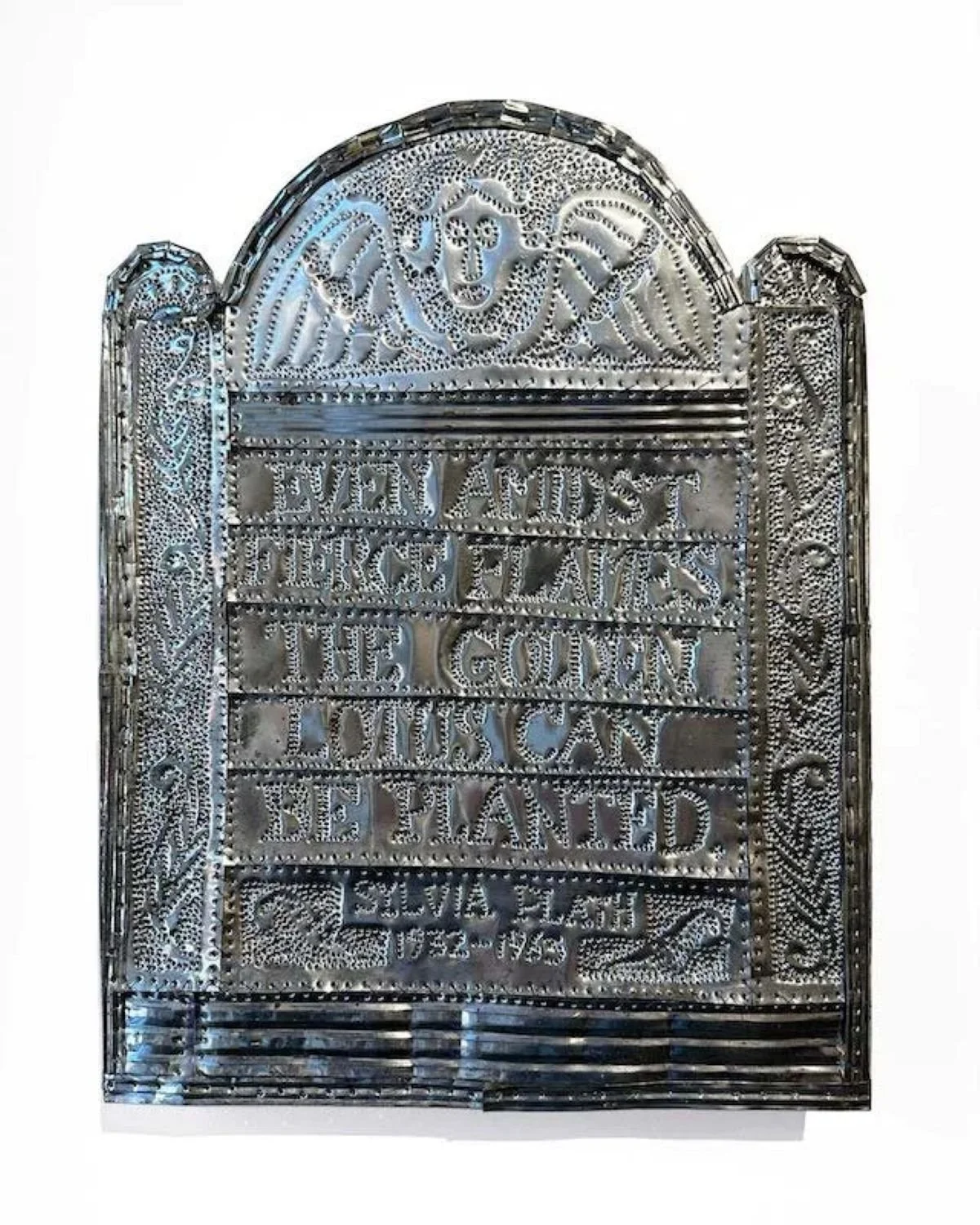
Ross Palmer Beecher, Sylvia Plath Memento Mori, 1983, Perforated tin and wire, 18 × 14 1⁄2 × 2 1⁄2 in, Courtesy of Greg Kucera Gallery, Seattle
The aesthetics of the New England graveyard show up again as inspiration for the Tombstones series. Five tombstones appear across the surface of Graveyard Quilt. The text and designs are embroidered by hand on muslin fabric. Beecher chose muslin because it is a humble fabric and one often used to make death shrouds for bodies. Two of the tombstones are cut off, suggesting a repetition and continuation past the borders of the quilt. A close look at one of the cut-off headstones reveals a macabre self-portrait of the artist. In the United States, the funerary industry has produced an art world all its own, with different regions often developing distinctive visual languages. Few American grave styles have become as iconic as those of New England. The arches across tops of the headstones inscribed with winged skulls atop a rectangular base packed with text, and even the font of that text, identify these tombstones as distinctly New England. This is a visual style that has fascinated Beecher since childhood, when she would often play in local graveyards, once even finding someone’s plot broken open with the soil sunken in and lying down in it so her friend could get a picture. Beecher is also interested in New England headstones as an authentic American folk-art practice, with the artists being nonspecialized working-class carvers who did other work for a living.
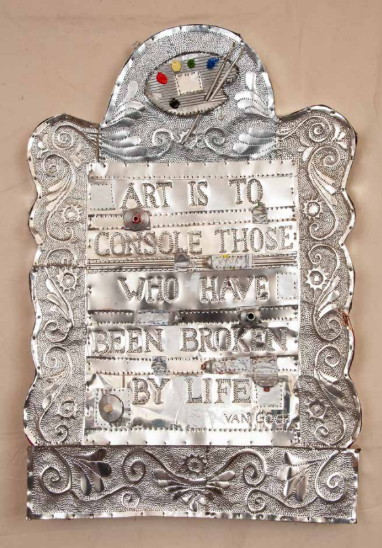
Ross Palmer Beecher, Van Gogh (Tombstone), 2021, Wired tin and paint, 30 × 20 × 2 in, Courtesy of Greg Kucera Gallery, Seattle
The tombstone designs were originally intended for another project in which Beecher would silkscreen them onto shirts, calling the project the Cemetery Shirtworks. When this project didn't turn out she decided to incorporate them into the Graveyard Quilt instead. Beecher continues to reference New England headstones in other sculptural projects. The first was her Sylvia Plath Memento Mori, from 1983, made out of perforated tin and wire. The wall-based sculpture maintains the basic composition common to New England headstones, a curved top with a winged angel head, symbolizing the soul’s flight to heaven and the promise of resurrection; decorative scrollwork along the sides: and a prominent quote across the surface reading, “Even amidst fierce flames the golden lotus can be planted.” Beecher’s sculpture is a metal replica of Plath’s gravestone in Heptonstall, West Yorkshire, chosen by her husband, Ted Hughes. The quote, a metaphor for the late author’s battle with depression, evokes the idea of creating beauty or enduring life amid extreme suffering or trauma. Not all Beecher’s tombstones are direct references to existing memorial markers. In her tombstone for Vincent van Gogh, she replaces the traditional winged figure at the top of the stone with an artist’s palette, equipped with two paintbrushes and paints at the ready. The inscription reads, “Art is to console those who have been broken by life,” Van Gogh’s own profound reflection on the power of creativity to mend wounded hearts. This reflection on art’s therapeutic powers is all the more relevant in light of Beecher’s work managing the art therapy program at Bailey-Boushay House, which provides care to people with HIV/AIDS as well as end-of-life care for people with ALS and other complex conditions.
While these pieces can be emotionally heavy, humor plays a significant role in Beecher’s interest in graveyard iconography. She is particularly drawn to graveyard humor in the form of witty epitaphs. Among her favorites, which she is able to recite from memory, goes something like: “Here lies the body of Solomon Pease; beneath these clouds and beneath these trees / But this ain't Pease—it's just the pod, Pease shelled out and went to God.” Graveyard Quilt is a reflection on death, particularly its universality, death as the great equalizer. Birth and death bookend everyone’s story. Across her Tombstones series and other various memento mori, in humor and in sorrow, in the leveling action of death, these sculptures remain poetic, theatrical, humbling, and poignant at the same time.