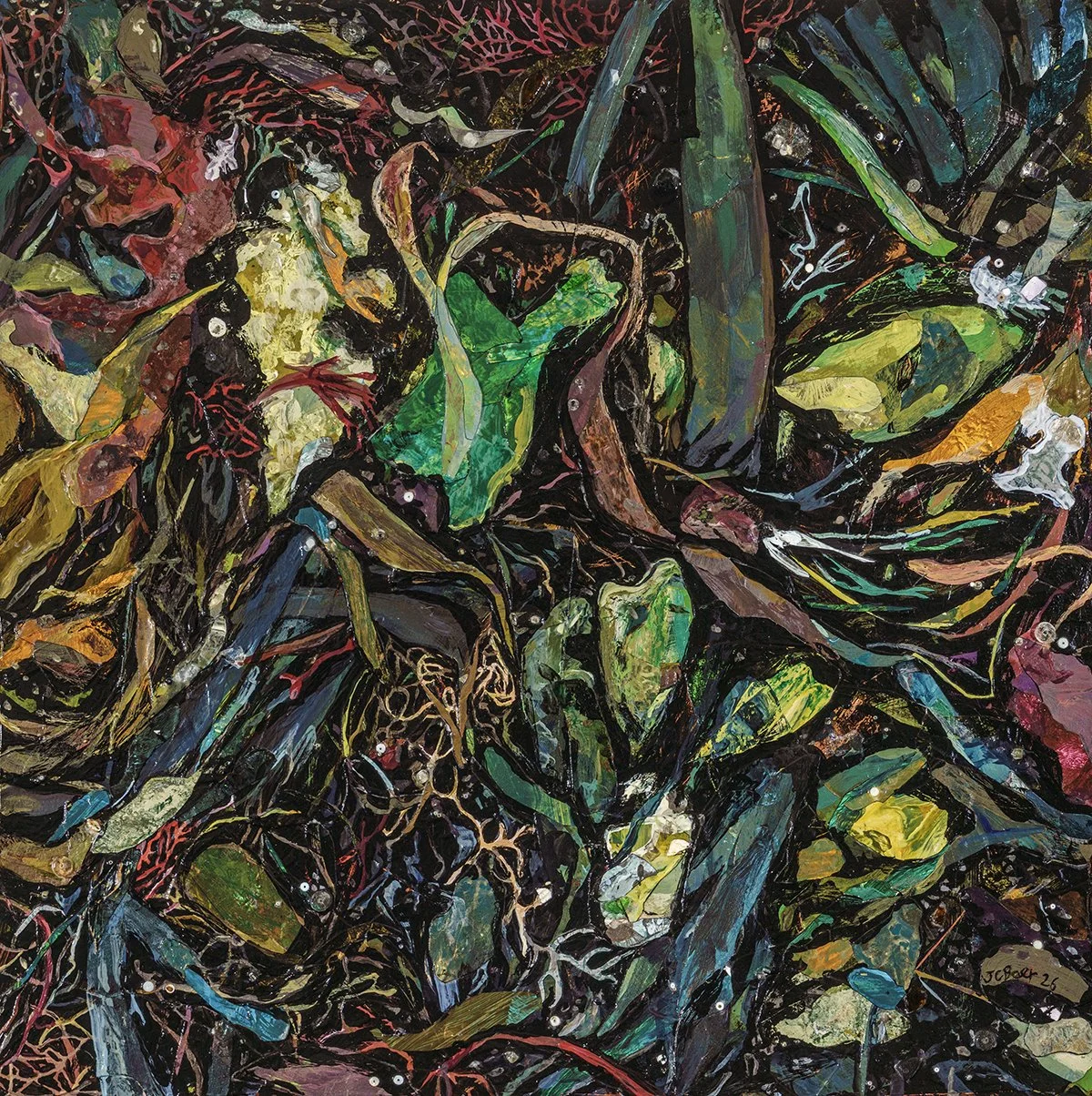
Surge: A Geography of Flow
October 3, 2026 - January 10, 2027
Guest-curated by Chloe Dye Sherpe
Surge: A Geography of Flow seeks to expand on the past iterations of Surge that examined displacement and agency by exploring the boundaries, currents, and complex systems that drive the movement of people, plants, animals, and natural elements caused by climate change. As the climate changes and significant weather events increase, understanding the dynamic environment will be crucial for decision-makers and the broader community. Water continues to flow, but to where and how? As researchers continue to develop mapping models for the impact of large storms and rising water, communicating these possibilities remains of paramount importance. How can society learn together to adapt to these changes? What does mapping the flow of these ever-changing and complex systems look like during the time of climate crisis?
Exhibition Timeline
Artist/Scientist Project Proposals are due March 6, 2026.
Selection Panel Review of Proposals
March 9 โ March 20, 2026
Selected Artists/Scientists contacted during the week of
March 23, 2026
Press Release announcing selection
by March 27, 2026
Exhibition Opening Date
October 3, 2026
Exhibition Dates
October 3, 2026 through January 10, 2027
Scientist Bios
-
Kathryn Sobocinski
Kathryn Sobocinski is an applied marine ecologist focusing on fishes, fish habitats, and impacts of human disturbance and climate change in coastal ecosystems. Kathryn authored the State of the Salish Sea and currently works on projects related to salmon survival in marine ecosystems, interactions between salmon and their prey and competitors, quantitatively assessing the cumulative effects of estuarine restoration for salmon, and marine ecology related to anthropogenic change within the Salish Sea and beyond. Kathryn is an Associate Professor in the Department of Environmental Sciences and the Marine and Coastal Science program at Western Washington University. She lives in Bellingham and likes to get on or in the water whenever possible.
-
Dave Peterson
Dave Peterson is Professor of Forest Biology at the University of Washington and an Emeritus Senior Scientist with the U.S. Forest Service. He has worked at the intersection of climate change science and resource management for 35 years, with additional research on wildfire science across the western United States. He has contributed to the Intergovernmental Panel on Climate Change and authored multiple chapters of the National Climate Assessment. He believes that art can inform and inspire public understanding of natural resource issues and has collaborated with artists in four previous Surge exhibits. He manages Mountain Heart Tree Farm in Skagit County where he lives.
wild@uw.edu
-
Roger Fuller
Roger Fuller coordinates the Natural Resources Stewardship program at Padilla Bay National Estuarine Research Reserve, one of 30 Estuarine Reserves across the country. He focuses on habitat restoration, invasive species management, and related monitoring and research. His background as an ecosystem ecologist includes research and restoration work in tidal wetlands, rivers, forests, and grasslands. Roger is a member of the Skagit Climate Science Consortium.
-
Jon Riedel
Jon Riedel is a retired National Park Service geologist whose academic and professional career have focused on understanding the climate history of Skagit Valley as it controlled the activity of glaciers, rivers, landslides, and volcanos. Jon has published many peer-reviewed studies on these topics, highlighted by several on glacial history. He is currently a Research Associate at Western Washington University, guiding graduate student research into Skagit Valleyโs geologic history. He serves on the board of directors for the Skagit Climate Science Consortium (since 2009), and is a U.S. Commissioner for the Skagit Environmental Endowment Commission (since 2022). Jon has enjoyed working with artists in all of the previous Surge exhibits. Collaborative efforts were fueled by mutual interest in the legacy of glaciers, with artists using glass, paper and paint to magnify their powerful messages.
-
Correigh Greene
Correigh Greene is a senior scientist with the Skagit River System Cooperative (SRSC). Correigh has a PhD in Animal Behavior from University of California Davis and has spent the last 24 years studying Pacific salmon, forage fish, and other species and their use of estuary and nearshore environments. Previously at NOAAโs Northwest Fisheries Science Center, Correigh is a founding member of SC2, leads the study of the response of salmon to estuary restoration, and continues a long-term collaboration to monitor fish populations in Skagit Bay. He has also long been interested in how creativity can inspire both good science and remarkable art.
-
Jeffrey Keck
Jeffrey Keck is a hydrologist and geomorphologist for the WA Department of Natural Resources. Jeff has a PhD in computational hydrology from the University of Washington and specializes in climate-driven sediment production and transport processes. At the WA Department of Natural Resources, Jeff helps foresters manage the landscape for recreation, wood and ecosystems in a way that minimizes anthropogenic effects on hydrologic and sediment production processes. Jeff has authored numerous publications on topics such as climate controls on landslides and modeling approaches for predicting sediment transport and debris flow behavior. Most recently, Jeff collaborated with Nicoleta Cristea, Ronda Strauch and Erkan Istanbulluoglu on a study that evaluated how climate change will affect landslide hazard in the North Cascades.
-
Aquila Flower
Aquila Flower is a geographer, ecologist, and climate scientist specializing in the forest, alpine, and coastal ecosystems of the Salish Sea and Cascadia Bioregions. They use methods drawn from cartography, GIS, statistics, and dendrochronology to analyze and visualize long-term patterns of environmental and climatic change. Aquila is a Professor of Environmental Studies and Director of the Spatial Institute at Western Washington University and author of the open access, digital, interactive Salish Sea Atlas.
-
Teal Potter
Teal Potter is a soil ecologist at Washington State Universityโs Center for Sustaining Agriculture & Natural Resources. She coordinates the Climate Analogs Academy, a grant funded training program that aims to empower U.S. Extension professionals to lead regional climate change adaptation in specialty crops. Teal currently works on a wide range of projects in agriculture from cover crops research to delivering climate grief trainings. Teal enjoys skiing, hiking, and painting bright landscapes.
-
Derek Smith
Derek Smith is a marine ecologist using shipwrecks and other submerged structures as amazing natural laboratories to study long term ecological processes in all marine habitats. Studying the effects of existing submerged structures, some having been acclimatizing to their ocean setting for hundreds or even thousands of years, will help inform engineers and managers how to bio-construct and monitor new structures which have the capability to enhance and promote ecosystems for a sustainable coexistence with our coastlines. Derek is a Research Assistant Professor in the Marine and Coastal Science program at Western Washington University and the Laboratory Manager at Shannon Point Marine Center. He lives in Anacortes with his wife and two daughters.
-
Bob Mitchell
Bob Mitchell is a hydrologist who has spent his 30-year career in the Geology Department at Western Washington University working with students on water-resource issues in the Puget Sound region. His main area of expertise is modeling mountain hydrology and hillslope processes. For the past 15 years Bob and his graduate students have been modeling the effects of projected climate change on snowpack, glacier recession, streamflow, and stream temperatures in the Nooksack and Stillaguamish River basins to inform salmon habitat management and restoration strategies. Bob lives in Bellingham, is a member of the Skagit Climate Science Consortium and serves on Whatcom Countyโs Climate Impact Advisory Committee.
-
Guillaume Mauger
Guillaume Mauger is the Washington State Climatologist and a research scientist at the UW Climate Impacts Group. Specializing in Climate Science, Guillaume works closely with communities across the Northwest to facilitate access to relevant climate science, grow the regionโs capacity to use climate information and engage in collaborative user-driven climate research. In all of these, Guillame focuses on the practical actions that people can take to build the regionโs resilience. For the Surge exhibit, Guillaume is particularly interested in art that can help people viscerally understand the impacts of climate change.
-
Sam Kastner
Sam Kastner is a coastal physical oceanographer in the Environmental Science department at Western Washington University. Sam is interested in coastal and estuarine circulation, mixing, and transport, and the impact of related physical processes on ecosystems and communities.
-
Nicoleta Cristea
Nicoleta Cristea is a hydrologist in the Department of Civil & Environmental Engineering at the University of Washington (UW) and a Senior Data Science Fellow at the UW eScience Institute. Her research leverages high-resolution remote sensing, physics-based numerical models, and machine learning to study freshwater systems and their responses to environmental change. She also co-developed community data science programs, including GeoSMART and eScience hack weeks, and supports training and open-source research in the geosciences. She actively collaborates with local communities, including Seattle City Light, the Nooksack Tribe, and the UW Climate Impacts Group, to ensure her research is grounded in the regionโs needs and priorities.
I am interested in portraying a future with less or no snow :(
-
Morgan Eisenlord
Morgan Eisenlord is a coastal marine ecologist who studies trophic interactions and infectious disease ecology. Her research focuses on how ecological processes that are invisible to the naked eye shape the lives of marine organisms. These hidden forces, which include microbes, microscopic algae, nutrients, and naturally occurring toxins, can function as food, disease, or poison, sometimes simultaneously. She is particularly interested in how environmental stress alters these interactions causing cascading effects through marine communities. Her current work examines how a toxin produced by stressed diatoms impacts early development in forage fish, vital food for salmon and many marine mammals. Morgan began studying sea star wasting disease during the early stages of the epidemic and continues to monitor disease prevalence and population impacts in local sea star communities. She is a part of an international IUCN effort to assess the stability of sea star species worldwide. She also investigates infectious disease transmission and host resilience in seagrasses and algae where disease can be a hidden driver of decline. She is a postdoctoral researcher in the Olson Lab at Western Washington Universityโs Shannon Point Marine Center.
-
Nina Whitney
Nina Whitney is a paleoclimatologist studying changes in ocean conditions over the last millennium. She is the Student Engagement Lead and a Research Assistant Professor in the Marine and Coastal Science program at Western Washington University. Ninaโs work primarily focuses on using the chemistry (isotopes) in bivalve shells to reconstruct past variability in temperature and ocean circulation in order to contextualize the current changes seen in our oceans today. The clams she focuses on live for hundreds of years (the longest-living animals in the world) and grow in annual increments just like trees, providing high-resolution, centuries-long records and oceanic change. Nina also incorporates climate and ocean models into her research to help interpret the shell records.